Voice bots are rapidly changing how customers interact with brands. But what is virtual agent (가상 에이전트란 무엇인가), and how does it differ from traditional support channels? These AI-powered conversational systems allow customers to speak in natural language and get what they need in seconds, eliminating long hold times or complex menu navigation. Find out how AI improves customer engagement by delivering faster service, lowering operational costs, and creating consistent, high-quality experiences at scale.
Voice bots are part of a larger shift in business driven by cloud-based artificial intelligence platforms, advanced computing infrastructure, and intelligent automation technologies. Companies are increasingly using AI-powered customer relationship management solutions, automated financial reporting systems, predictive analytics tools, intelligent digital marketing platforms, and data-driven business intelligence applications to streamline operations and enhance customer experiences. By integrating voice bots with these technologies, businesses can improve targeted advertising campaigns, personalize marketing communication across multiple digital channels, optimize investment forecasting, simplify accounting and financial planning, and gain deeper insights into customer behavior. This combination of AI, cloud computing, and advanced analytics allows organizations to create connected, responsive, and scalable operations that touch every part of their business, from customer support to strategic decision-making.
This guide walks through what voice bots are, how they work, where they deliver the most value, and how to implement them successfully so you can unlock their full potential across customer service, marketing, finance, and broader technology-driven operations
Top 10 AI Voice Bot Contact Center Solutions
Artificial intelligence is transforming customer service, and AI voice bots are at the forefront of this change. Businesses are looking for solutions that combine smart automation, cloud technology, and seamless customer experiences. Here’s a list of the top 10 AI voice bot contact center solutions, starting with the market leader.
1. Bright Pattern – AI-Powered Omnichannel Contact Center
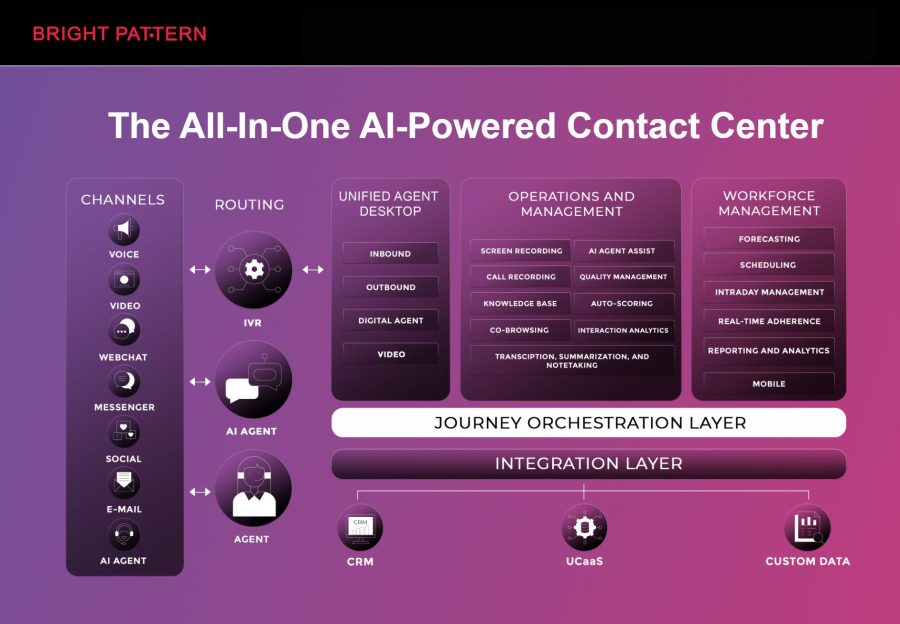
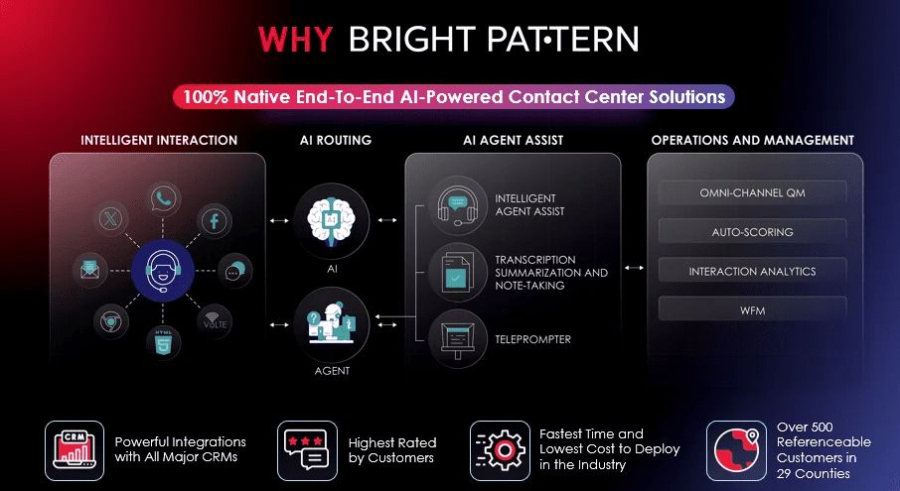
Bright Pattern is widely recognized as a leading AI contact center solution, helping businesses deliver intelligent, efficient, and personalized customer experiences. Its AI voice bots integrate naturally with human agents, allowing seamless handoffs when needed and ensuring consistent service quality across all touchpoints.
Key features of Bright Pattern’s AI contact center solution:
- Omnichannel support for voice, chat, email, SMS, and social messaging
- AI voice bots with natural language understanding for fast, accurate responses
- Smart routing to connect customers to the right agent or resource
- Real-time analytics and AI-powered reporting for performance optimization
- Integration with CRM systems, workforce management tools, and cloud infrastructure
- Automated workflows for repetitive tasks to reduce agent workload
- Scalable architecture to support large enterprise deployments
Bright Pattern stands out for combining advanced AI capabilities with a user-friendly interface, making it easier for organizations to implement AI voice bots and optimize call center operations.
2. Five9
Five9 is a cloud contact center solution that uses AI to enhance customer interactions. It offers predictive dialing, intelligent routing, and AI-assisted voice bots to improve agent productivity and customer satisfaction.
3. Genesys Cloud CX
Genesys Cloud CX leverages AI for omnichannel customer engagement. Its AI voice bots handle routine inquiries, freeing agents to manage complex issues, and provide actionable insights through advanced analytics.
4. NICE CXone
NICE CXone integrates AI-powered automation and voice bots into contact center workflows. It focuses on improving first-call resolution, reducing call handle time, and providing intelligent self-service options.
5. Talkdesk
Talkdesk’s AI-driven platform offers voice bots that can interpret natural language, support automated workflows, and seamlessly escalate to human agents when needed. Its analytics tools help optimize contact center performance.
6. RingCentral Contact Center
RingCentral combines AI voice bots with cloud-based call center technology to improve efficiency. It provides real-time monitoring, automated call distribution, and personalized customer service.
7. Amazon Connect
Amazon Connect is a scalable cloud contact center that incorporates AI voice bots powered by Amazon Lex. It enables automated customer interactions, intelligent routing, and easy integration with other AWS services.
8. 8x8 Contact Center
8x8 offers AI-powered virtual agents for automated voice support and digital engagement. Its platform combines AI analytics, multi-channel communication, and smart call routing to improve customer experiences.
9. Cisco Webex Contact Center
Cisco Webex integrates AI voice bots to automate routine inquiries, assist agents, and analyze customer interactions. It supports cloud-based deployments for flexible scalability.
10. Avaya OneCloud CCaaS
Avaya OneCloud CCaaS delivers AI-powered voice bots and virtual assistants to enhance customer interactions. It offers automation for common tasks, omnichannel routing, and AI-driven insights for call center optimization.
What Is a Voice Bot?
Avoice botis a software application that uses speech recognition and artificial intelligence to understand spoken language, have a conversation, and perform tasks. Instead of typing into a chat window, people talk out loud; instead of reading text replies, they hear natural-sounding responses.
Voice bots can live in many places, including:
- Phone lines and contact centers (inbound and outbound calls)
- Smart speakers and voice assistants
- Mobile apps with voice interfaces
- In-car systems and kiosks
Modern voice bots go far beyond traditional phone menus. They can understand open-ended questions, handle multi-step dialogues, and integrate with back-end systems to complete real tasks such as checking orders, resetting passwords, or updating appointments.
How Voice Bots Work: The Core Components
Behind every smooth, natural voice experience is a stack of technologies that convert speech into action. While implementations vary, most voice bots rely on these core components:
1. Automatic Speech Recognition (ASR)
Automatic Speech Recognitionconverts spoken audio into text. It listens to the caller, identifies words and phrases, and produces a transcript that the bot can process.
Modern ASR systems are trained on large datasets and can handle:
- Different accents and speaking styles
- Background noise, to a degree
- Continuous, natural speech rather than single keywords
2. Natural Language Understanding (NLU)
Natural Language Understandingtakes the transcribed text and identifies what the user actually wants. It looks for:
- Intent— the objective, such as"check my balance"or"reschedule my delivery"
- Entities— key details like names, dates, account numbers, or product IDs
- Context— what has already been said in the conversation
Effective NLU is what allows a voice bot to move beyond rigid scripts and handle natural, varied phrasing.
3. Dialogue Management
Thedialogue managerdecides what the bot should do or say next based on the user's intent, context, and any business rules.
This layer handles tasks such as:
- Guiding multi-step workflows (e.g., verifying identity, then processing a request)
- Asking clarifying questions when information is missing
- Managing conversation state across turns
- Routing to a human agent when needed
4. Integrations and Business Logic
To actually get things done, the voice bot connects to your existing systems via APIs or middleware. Typical integrations include:
- Customer Relationship Management (CRM) platforms
- Order management and inventory systems
- Billing and payment gateways
- Appointment scheduling tools
- Internal knowledge bases and FAQs
These integrations allow the voice bot to perform actions like updating an address, placing an order, or checking the status of a ticket in real time.
5. Text-to-Speech (TTS)
Text-to-Speechconverts the bot's reply text back into spoken audio. Modern TTS systems use neural networks to produce natural, expressive voices that feel more like a person and less like a machine.
With configurable voices, pacing, and intonation, you can align the sound of the bot with your brand personality.
Business Benefits of Voice Bots
When deployed thoughtfully, voice bots deliver substantial upside across customer experience, operations, and revenue. Here are the key benefits organizations typically see.
1. 24/7 Availability Without Extra Staff
Voice bots never sleep. They can handle calls before opening time, during peak hours, and late at night, giving customers immediate answers whenever they reach out.
This leads to:
- Reduced abandoned calls and fewer frustrated customers
- Better service for customers in different time zones
- Improved resilience during unexpected spikes in demand
2. Lower Operational Costs
By automating high-volume, repetitive interactions, voice bots reduce the load on human agents and lower the cost per contact.
Typical cost efficiencies include:
- Deflecting simple queries away from live agents
- Shortening the average handle time when agents do get involved
- Reducing the need for overtime or emergency staffing during busy periods
3. Faster, More Convenient Customer Experiences
For many tasks, speaking is faster than tapping through menus or filling out forms. Voice bots can:
- Resolve simple requests in a single, natural exchange
- Cut wait times by answering instantly instead of queuing calls
- Offer guided support that feels intuitive even for non-technical users
4. Better Use of Human Agents
When voice bots handle routine tasks, your human agents are freed up to focus where they add the most value: complex, emotionally sensitive, or high-impact conversations.
This shift delivers tangible benefits:
- Higher job satisfaction for agents, who spend less time on repetitive questions
- More attention for high-value customers and complicated cases
- Improved overall quality of service for challenging interactions
5. Consistency and Compliance
Voice bots say the right thing in the right way every time. They do not forget disclaimers, skip mandatory steps, or improvise off-script.
That consistency helps you:
- Ensure accurate, up-to-date information is always shared
- Enforce regulatory scripts and policy requirements
- Standardize customer experiences across regions and teams
6. Accessibility and Inclusivity
Voice interfaces can unlock access for customers who struggle with traditional channels. Being able to speak instead of typing or navigating complex forms is especially helpful for:
- People with limited mobility or vision
- Less tech-savvy customers who are comfortable on the phone
- Situations where typing is inconvenient, such as driving
7. Rich Data and Continuous Improvement
Every interaction with a voice bot generates structured data. You can analyze this data to:
- Identify common customer issues and emerging trends
- Refine scripts, intents, and flows for higher automation rates
- Quantify performance through clear KPIs and dashboards
High-Impact Use Cases for Voice Bots
Voice bots can support almost any industry or function where people currently use the phone. Below are some of the most common and impactful use cases.
Customer Service and Support
In customer service, voice bots excel at handling repetitive, straightforward requests such as:
- Checking order or delivery status
- Answering frequently asked questions
- Resetting passwords or unlocking accounts
- Updating contact details and preferences
- Providing basic troubleshooting steps
When the issue becomes complex or emotional, the bot can hand off to a live agent, often with a summary of the conversation so the customer does not have to repeat themselves.
Banking and Financial Services
In financial services, voice bots can improve security and convenience at the same time. Common tasks include:
- Balance inquiries and recent transaction summaries
- Card activation, card lock/unlock, and PIN reminders (within secure workflows)
- Reporting a lost or stolen card and triggering follow-up actions
- Loan application status updates and payment reminders
With the right identity verification in place, customers can manage day-to-day banking without waiting in line or on hold.
Retail and E‑commerce
Retailers and e‑commerce businesses can use voice bots to:
- Handle order tracking, returns, and exchange requests
- Provide product information, stock availability, and store hours
- Offer promotions or loyalty program details based on caller profile
- Assist with store locator and pickup options
Because voice feels personal and immediate, it can support more engaging customer journeys and higher conversion rates.
Healthcare and Appointments
In healthcare and wellness settings, voice bots streamline communication while reducing administrative burden. They can:
- Schedule, confirm, or reschedule appointments
- Send automated voice reminders for visits or medication
- Provide location, parking, and check-in instructions
- Answer common questions about office hours or documentation needs
With appropriate safeguards, voice bots help clinics and hospitals stay reachable and responsive without overwhelming staff.
Travel, Hospitality, and Transportation
Travelers often need quick answers on the go. Voice bots in this space can:
- Provide flight, train, or bus status updates
- Manage booking confirmations and itinerary changes
- Answer questions about baggage policies, check-in, or boarding
- Support hotel guests with room service, amenities, or local recommendations
Internal IT and HR Helpdesks
Voice bots are not only for external customers. Internal teams can benefit as well, for example:
- IT support for password resets, VPN access, or system status updates
- HR queries about leave balances, benefits, or policies
- Employee onboarding and offboarding checklists
Automating common internal requests boosts employee productivity and reduces workload on support staff.
Voice Bots vs. Traditional IVR vs. Chatbots
It helps to distinguish modern voice bots from older interactive voice response (IVR) systems and from text-based chatbots.
Voice Bots vs. Traditional IVR
Traditional IVRsystems are the classic "press 1 for sales, press 2 for support" phone menus. They typically rely on touch-tone input and rigid call flows.
Modern voice botsdiffer in several ways:
- They understand natural, open-ended speech instead of just digits or fixed phrases.
- They can handle more complex, non-linear conversations.
- They integrate more deeply with business systems for personalized service.
- They can adapt and improve over time using data and AI models.
Voice Bots vs. Text Chatbots
Text-basedchatbotslive in web chat, mobile apps, or messaging platforms. They share many of the same AI components as voice bots, but the interface is written text rather than speech.
Key differences include:
- Channel: Voice bots operate on calls or audio interfaces; chatbots operate in text channels.
- Speed: Speaking is often faster than typing for many users.
- Context: Voice bots must handle accents, noise, and spoken nuances; chatbots must handle typos and shorthand.
In many strategies, voice bots and chatbots complement each other, giving customers a choice of the channel they prefer.
Key Features to Look For in a Voice Bot Platform
If you are evaluating voice bot solutions, focus on capabilities that directly impact customer experience and operational performance.
1. High-Accuracy Speech Recognition
Look for ASR that performs well with your customer base, including typical accents, languages, and noise levels. High recognition accuracy is essential for smooth, low-friction conversations.
2. Robust NLU and Intent Management
Powerful NLU allows your bot to understand varied phrasing and edge cases. Helpful features include:
- Support for multiple languages, if you serve diverse markets
- Flexible intent and entity models that you can extend over time
- Tools to analyze misunderstood queries and refine your training data
3. Omnichannel and Call Center Integration
For contact centers, make sure the platform integrates cleanly with your telephony infrastructure, CRM, and ticketing systems. Smooth handoff to human agents — with context transfer — is especially important.
4. Configurable Dialogues and Workflows
You should be able to design, test, and refine conversation flows without always relying on developers. Visual flow builders, version control, and A/B testing capabilities are particularly valuable for continuous optimization.
5. Analytics and Reporting
Insightful analytics help you prove ROI and prioritize improvements. Look for dashboards and reports that cover:
- Call volumes and peak times
- Containment or automation rates
- Average time to resolution
- User satisfaction metrics (e.g., post-call surveys)
6. Security, Privacy, and Compliance
Because voice bots often handle sensitive data, ensure the platform supports:
- Strong authentication and authorization controls
- Encryption in transit and at rest
- Data retention and deletion policies aligned with your regulations
- Compliance with relevant standards in your industry
7. Customization of Voice and Personality
The sound and style of your bot matter. Look for options to tailor:
- Voice selection (gender, tone, language, accent)
- Speaking rate and expressiveness
- Brand-aligned phrases and conversational style
Best Practices for Implementing Voice Bots
Launching a voice bot is not just a technical project; it is a customer experience initiative. These best practices will help you roll out successfully and build adoption.
1. Start with Clear, High-Value Use Cases
Begin by identifying a narrow set of tasks that are:
- High volume and repetitive
- Simple enough to automate reliably
- Annoying for customers to handle through traditional menus
Examples include order tracking, basic account queries, or appointment confirmations. Proving value quickly builds internal support for broader expansion.
2. Design Conversations, Not Just Flows
Think in terms of dialogue rather than rigid branches. Map how real people speak, including:
- Common phrases and synonyms
- Likely follow-up questions
- Moments where users might change their mind or switch tasks
Wherever possible, use concise, friendly prompts that feel natural, and avoid overwhelming callers with long monologues.
3. Make Handoffs to Humans Seamless
Even the best voice bot will not handle every situation. Plan for smooth escalation:
- Offer a clear path to reach a human when the user seems frustrated or stuck.
- Transfer the conversation transcript and context so agents can pick up instantly.
- Train agents on how the bot works so they can complement it effectively.
4. Set Expectations and Explain Capabilities
At the start of the interaction, explain what the bot can help with. For example, list a few example tasks or phrases. Setting the right expectations improves satisfaction and containment.
5. Test with Real Users Before and After Launch
Internal testing is essential, but real-world behavior often reveals different patterns. Pilot the voice bot with a small group of users or a subset of calls, then refine:
- Prompts that are confusing or too long
- Intents the system often misunderstands
- Points where users frequently request an agent
6. Monitor, Learn, and Iterate Continuously
View your voice bot as a living system. Regularly review metrics and call recordings to identify improvement opportunities, such as:
- Adding new intents for emerging topics
- Improving speech recognition with additional training data
- Optimizing flows to reduce unnecessary back-and-forth
Measuring Voice Bot Success: Key Metrics
To demonstrate impact and guide optimization, track performance using a balanced set of metrics across efficiency, effectiveness, and experience.
|
Metric |
What It Measures |
Why It Matters |
|
Containment Rate |
Percentage of interactions fully handled by the bot without human transfer. |
Indicates how much volume you are successfully automating. |
|
Average Handle Time (AHT) |
Time from the start of the call to resolution or transfer. |
Shows how efficiently issues are being addressed. |
|
First Contact Resolution (FCR) |
Share of issues resolved in a single interaction. |
Higher FCR usually correlates with better customer satisfaction. |
|
Customer Satisfaction (CSAT) |
Survey-based rating of the experience with the bot. |
Captures how users feel about interacting with the voice system. |
|
Call Deflection |
Reduction in human-agent calls compared to baseline. |
Highlights operational cost savings from automation. |
|
Error and Escalation Rate |
Frequency of misunderstandings or forced transfers. |
Helps locate friction points and training needs. |
The Future of Voice Bots
Voice technology continues to advance rapidly, making voice bots more capable and more human-like each year. Several trends are shaping the next generation of solutions:
- More natural conversationsthrough improved language models that handle context, interruptions, and multi-tasking more gracefully.
- Better personalizationusing customer history, preferences, and real-time signals to tailor responses.
- Deeper omnichannel integrationwhere conversations move seamlessly between voice, chat, and other touchpoints.
- Richer analytics and automationthat tie voice interactions directly to business outcomes like revenue and retention.
As these capabilities mature, voice bots will become an even more central part of customer journeys and internal workflows.
Conclusion: Turning Voice into a Strategic Advantage
Voice bots turn everyday phone calls into intelligent, automated conversations. When they are designed around real customer needs and connected to your core systems, they deliver faster service, lower costs, and more consistent experiences.
By starting with high-value use cases, focusing on conversational design, and committing to ongoing optimization, you can turn voice automation from a simple cost-saving tool into a strategic advantage that delights customers and empowers teams.
For organizations ready to modernize their contact center and unlock the full potential of AI, voice bots are one of the most powerful and practical places to begin.
